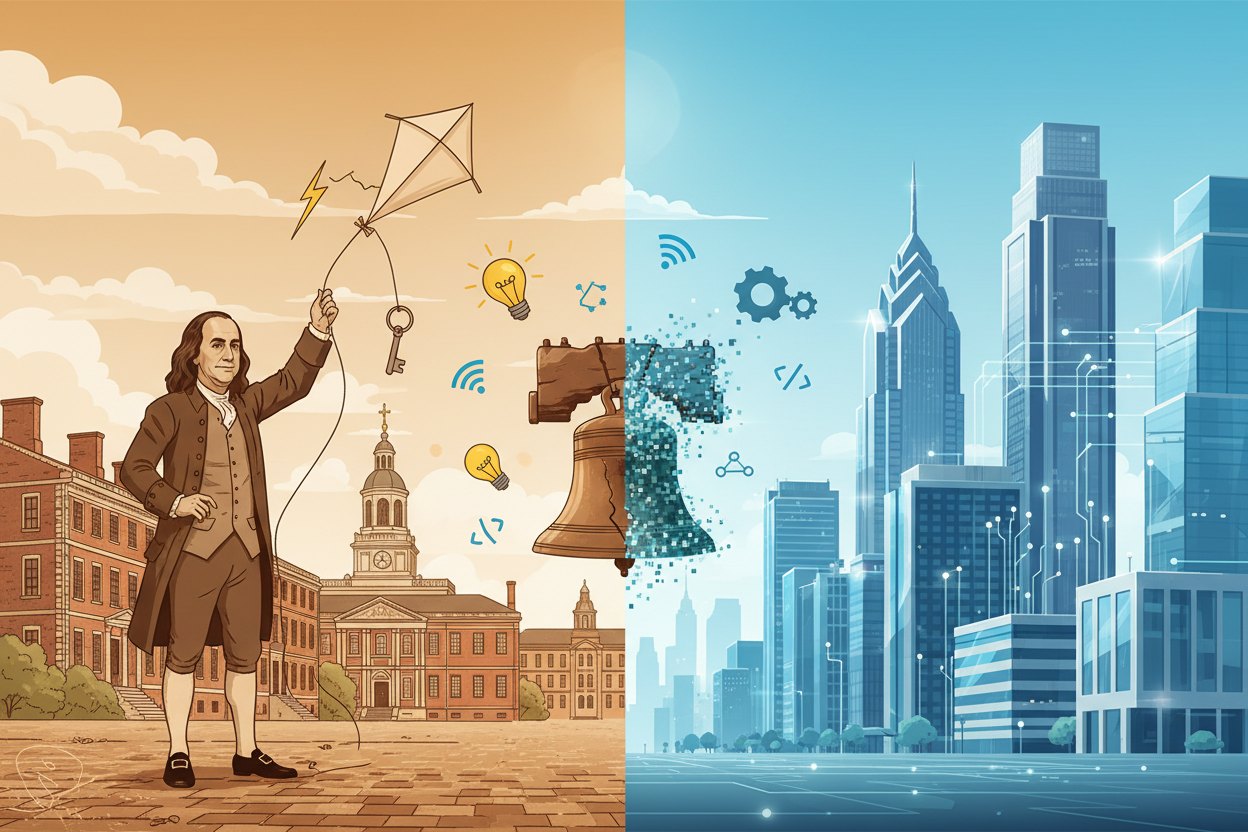
Why Benjamin Franklin Would Love Modern Philadelphia: Tech, Innovation, and Progress
Imagine Benjamin Franklin walking down Market Street today, smartphone in hand, marveling at the electric buses humming past Independence Hall. The man who once flew a kite in a thunderstorm to unlock electricity’s secrets would be absolutely fascinated by Philadelphia’s transformation into a thriving tech hub. The City of Brotherly Love has evolved far beyond Franklin’s wildest dreams, yet it maintains the same spirit of innovation and progress that he embodied centuries ago.
Philadelphia today pulses with the same entrepreneurial energy that Franklin brought to colonial America. From biotech breakthroughs to fintech innovations, from world-class universities to cutting-edge startups, modern Philly would make its founding father beam with pride. Let’s explore why Benjamin Franklin would feel right at home in today’s Philadelphia, surrounded by the very innovations he helped inspire.
Franklin’s Legacy of Innovation Lives On
Benjamin Franklin wasn’t just a founding father – he was America’s first tech entrepreneur. The man who invented bifocals, the lightning rod, and the Franklin stove understood that innovation drives progress. He founded America’s first public library, first fire department, and first public hospital. Most importantly, he believed in the power of collaboration and knowledge sharing to benefit society.
These principles echo loudly through Philadelphia’s modern innovation ecosystem. The city has embraced Franklin’s collaborative spirit, creating spaces where entrepreneurs, researchers, and investors work together to solve complex problems. Just as Franklin brought together brilliant minds to discuss science and philosophy, today’s Philadelphia brings together diverse talents to tackle everything from climate change to healthcare accessibility.

Franklin’s approach to problem-solving – practical, methodical, and always focused on public benefit – mirrors the mindset of many modern Philadelphia innovators. He would appreciate how the city’s tech community doesn’t just chase profits but seeks to create meaningful impact for communities both local and global.
Philadelphia’s Thriving Technology Ecosystem
Modern Philadelphia has become a powerhouse in the technology sector, with over 5,000 tech companies calling the region home. The city’s tech scene generates billions in revenue annually and continues to attract top talent from around the world. Franklin, who valued practical applications of scientific knowledge, would be thrilled to see how Philadelphia has become a leader in applied technology.
The city’s strategic location between New York and Washington, D.C., combined with significantly lower costs than these major metros, has created an attractive environment for tech companies. Major players like Comcast, SAP, and Oracle have significant operations here, while homegrown success stories like Sidecar Health and Curalate demonstrate the city’s entrepreneurial spirit.
Franklin would particularly appreciate Philadelphia’s focus on “civic tech” – technology solutions designed to improve government services and citizen engagement. The city has pioneered digital initiatives that make government more transparent and accessible, from online permit systems to data-driven policy making. This commitment to using technology for public good aligns perfectly with Franklin’s belief in civic responsibility.
World-Class Universities Driving Research and Development
Philadelphia’s concentration of prestigious universities would absolutely delight Franklin, who founded the University of Pennsylvania in 1740. Today, the city hosts world-renowned institutions including UPenn, Drexel University, Temple University, and Thomas Jefferson University, creating an unparalleled ecosystem for research and development.
The University of Pennsylvania alone conducts over $1 billion in research annually, with groundbreaking work in artificial intelligence, robotics, and biotechnology. Franklin, who valued education and scientific inquiry above all else, would be amazed by the resources these institutions dedicate to pushing the boundaries of human knowledge.
These universities don’t just conduct research in isolation – they actively collaborate with industry partners and startup companies. Programs like Penn’s Weiss Tech House and Drexel’s ExCITe Center create direct pathways for academic research to become real-world solutions. Franklin, who always sought practical applications for his scientific discoveries, would applaud this approach to bridging academia and industry.
The talent pipeline these institutions create is remarkable. Philadelphia graduates thousands of engineers, scientists, and entrepreneurs each year, many of whom choose to stay and build their careers in the city. This creates a self-reinforcing cycle of innovation that Franklin, with his deep appreciation for education’s role in society, would find deeply satisfying.
Biotech and Life Sciences: Healing the World
Perhaps nowhere would Franklin’s excitement be more evident than in Philadelphia’s life sciences sector. The man who co-founded Pennsylvania Hospital would be astounded by the city’s emergence as a global leader in biotechnology and pharmaceutical innovation. Philadelphia now ranks among the top biotech clusters in the United States, with over 700 life sciences companies in the region.
The city’s biotech prowess spans from established pharmaceutical giants like GlaxoSmithKline to cutting-edge startups developing revolutionary treatments. Companies working on gene therapy, immunotherapy, and personalized medicine call Philadelphia home. Franklin, who was always concerned with improving human health and welfare, would be fascinated by these advances.
The Children’s Hospital of Philadelphia (CHOP) exemplifies this innovation, conducting world-leading research in pediatric medicine while spinning off successful biotech companies. The hospital’s research institute has launched dozens of startups, creating a unique model that Franklin – with his practical approach to turning ideas into beneficial applications – would surely admire.
Philadelphia’s life sciences sector also demonstrates the collaborative spirit Franklin championed. The city’s BioLabs and other shared research facilities allow small companies to access expensive equipment and expertise, democratizing innovation in ways that would warm Franklin’s egalitarian heart.
Fintech Revolution: Modernizing Money and Commerce
Franklin, who established one of America’s first banks and understood the importance of sound financial systems, would be captivated by Philadelphia’s emerging fintech sector. The city has become a hub for financial technology innovation, with companies developing everything from digital payment systems to blockchain applications.
Philadelphia’s fintech companies are tackling real-world problems that affect everyday people – from making banking more accessible to underserved communities to streamlining small business lending. This focus on practical solutions that benefit society aligns perfectly with Franklin’s philosophy of innovation for the common good.
The city’s established financial services sector provides a strong foundation for fintech innovation. Major banks and insurance companies headquartered in Philadelphia are actively partnering with startups and investing in new technologies. Franklin, who understood the importance of established institutions embracing change, would appreciate this collaborative approach to financial innovation.
Companies like Sidecar Health are revolutionizing healthcare payments, while others are developing new approaches to cryptocurrency and digital banking. Franklin’s keen interest in economics and his practical approach to solving financial challenges would make him a natural ally to today’s fintech entrepreneurs.
Sustainable Innovation and Clean Technology
Franklin’s scientific mind would be deeply engaged by Philadelphia’s growing clean technology sector. The city has committed to ambitious sustainability goals, including carbon neutrality by 2050, and is fostering innovation in renewable energy, energy efficiency, and environmental technology.
Philadelphia’s clean tech companies are developing solutions for everything from solar energy storage to waste reduction. The city’s Energy Works program supports entrepreneurs working on energy-related innovations, providing the kind of institutional support for scientific advancement that Franklin advocated throughout his life.
The city’s commitment to sustainable transportation would particularly appeal to Franklin, who was always interested in improving urban life. Philadelphia’s expansion of bike lanes, electric vehicle charging infrastructure, and public transit improvements demonstrate the same systematic approach to civic improvement that Franklin pioneered.
Local universities are conducting cutting-edge research in environmental science and sustainable technology, often in partnership with city government and private companies. This collaborative approach to solving environmental challenges embodies Franklin’s belief that science should serve society’s needs.
The Future Franklin Would Envision
As we look toward Philadelphia’s future, it’s clear that the city is building on the foundation Franklin laid centuries ago. The same principles that guided him – curiosity, collaboration, practical innovation, and civic responsibility – continue to drive Philadelphia’s evolution into a modern innovation hub.
Franklin would be particularly excited about emerging technologies like artificial intelligence, quantum computing, and advanced manufacturing that are beginning to take root in Philadelphia. The city’s research institutions and growing tech sector are well-positioned to be leaders in these next-generation technologies.
The integration of technology with Philadelphia’s rich cultural heritage would also appeal to Franklin, who valued both progress and tradition. The city’s efforts to preserve its historical character while embracing innovation create exactly the kind of balanced approach to development that Franklin advocated.
Most importantly, Philadelphia’s continued commitment to using innovation for social good would make Franklin proud. From healthcare breakthroughs that save lives to civic tech that improves government services, the city maintains his vision of progress that benefits all citizens, not just the wealthy few.
Benjamin Franklin’s Philadelphia was a city of firsts – first library, first hospital, first fire department. Today’s Philadelphia continues that tradition, pioneering new technologies and approaches that will shape the future. The founding father who once wrote “An investment in knowledge pays the best interest” would be thrilled to see how his adopted city has become a place where knowledge, innovation, and civic responsibility converge to create a better tomorrow for all.