The Evolution of Philadelphia’s Skyline: From William Penn to Modern Towers
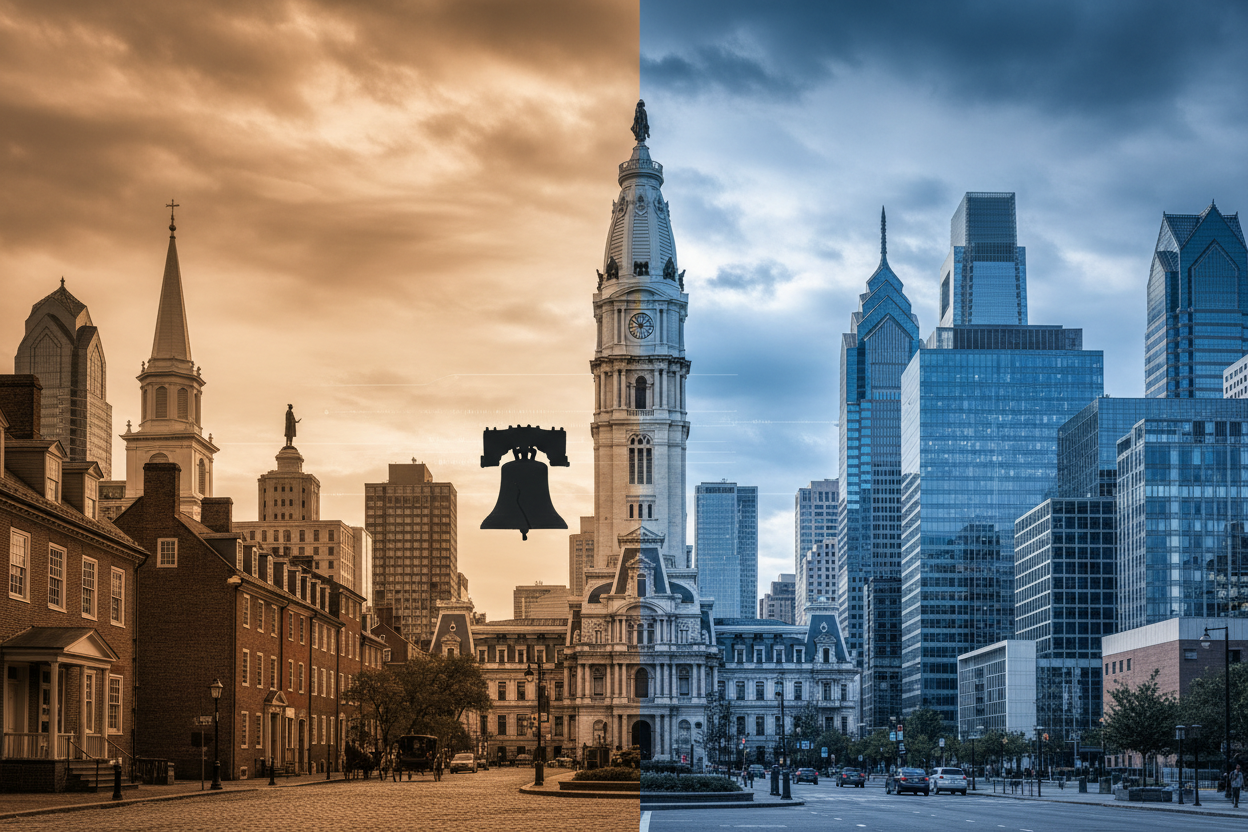
Standing at the observation deck of City Hall today, gazing out at Philadelphia’s sprawling urban landscape, it’s hard to imagine this bustling metropolis once existed under a peculiar “gentleman’s agreement” that kept buildings respectfully below the brim of William Penn’s hat. The City of Brotherly Love has undergone one of America’s most fascinating architectural transformations, evolving from a colonial grid of modest structures to a dynamic skyline that tells the story of American ambition, innovation, and urban growth.
Philadelphia’s skyline evolution represents more than just changing building heights—it’s a visual timeline of American history, economic shifts, and architectural movements that have shaped one of the nation’s oldest cities. From the humble brick buildings of the 1600s to today’s gleaming glass towers, each era has left its distinctive mark on the cityscape, creating a unique blend of historical preservation and modern development that sets Philadelphia apart from other major American cities.
The Colonial Foundation: William Penn’s Vision Takes Shape
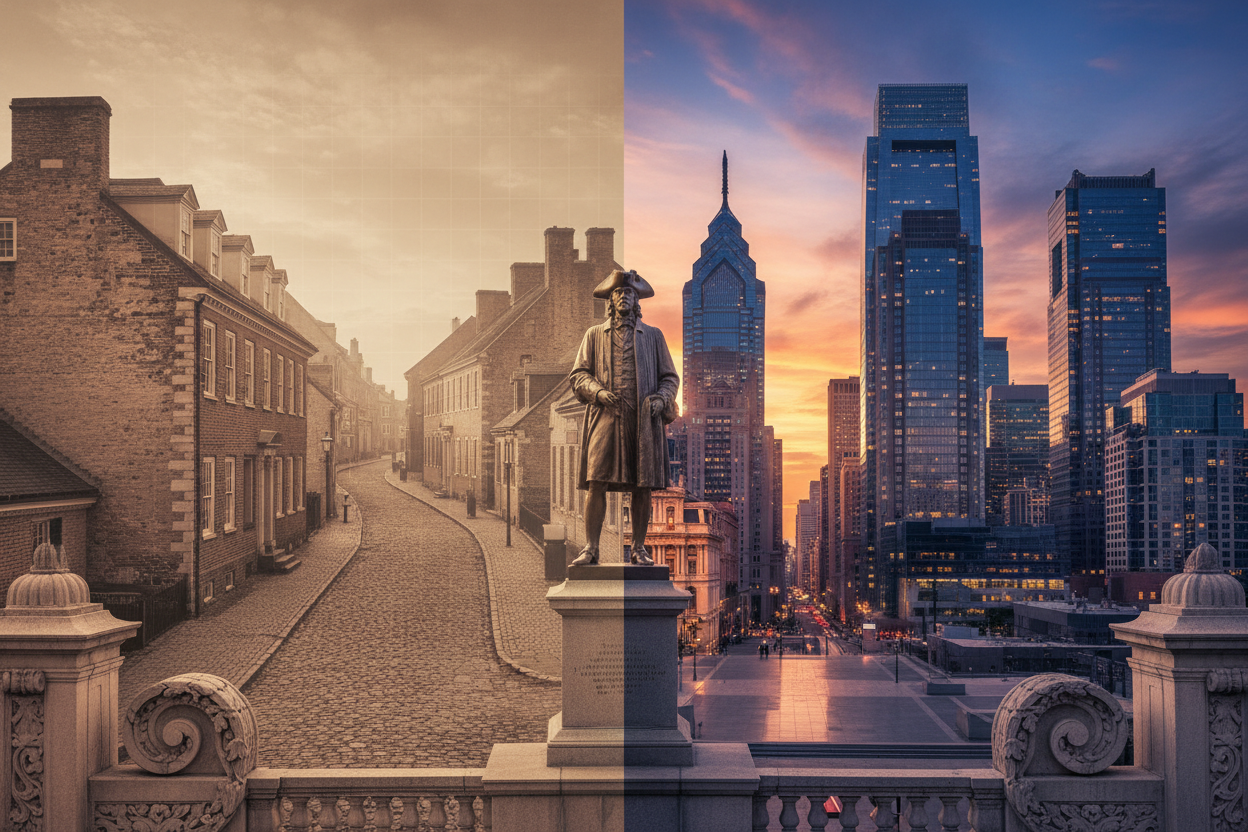
When William Penn founded Philadelphia in 1682, he envisioned something revolutionary for its time: a “greene country towne” with wide streets, public squares, and buildings that wouldn’t crowd together like London’s fire-prone structures. Penn’s original city plan established the grid system that still defines Center City today, with Broad and Market Streets serving as the main arteries intersecting at what would eventually become City Hall.
The earliest Philadelphia skyline was refreshingly horizontal. Colonial buildings rarely exceeded three stories, constructed primarily of local fieldstone and brick. The most prominent structures were churches and public buildings, with Christ Church’s 196-foot steeple dominating the skyline from 1754 until well into the 19th century. These modest structures reflected both the Quaker values of simplicity and the practical limitations of 18th-century construction techniques.
Independence Hall, completed in 1753, became another defining feature of early Philadelphia’s skyline. Its Georgian architecture and modest bell tower represented the pinnacle of colonial civic architecture, though at just 168 feet, it maintained the human scale that characterized the era. The building’s enduring presence in today’s skyline serves as a powerful reminder of Philadelphia’s foundational role in American history.
Industrial Revolution: The City Reaches Upward
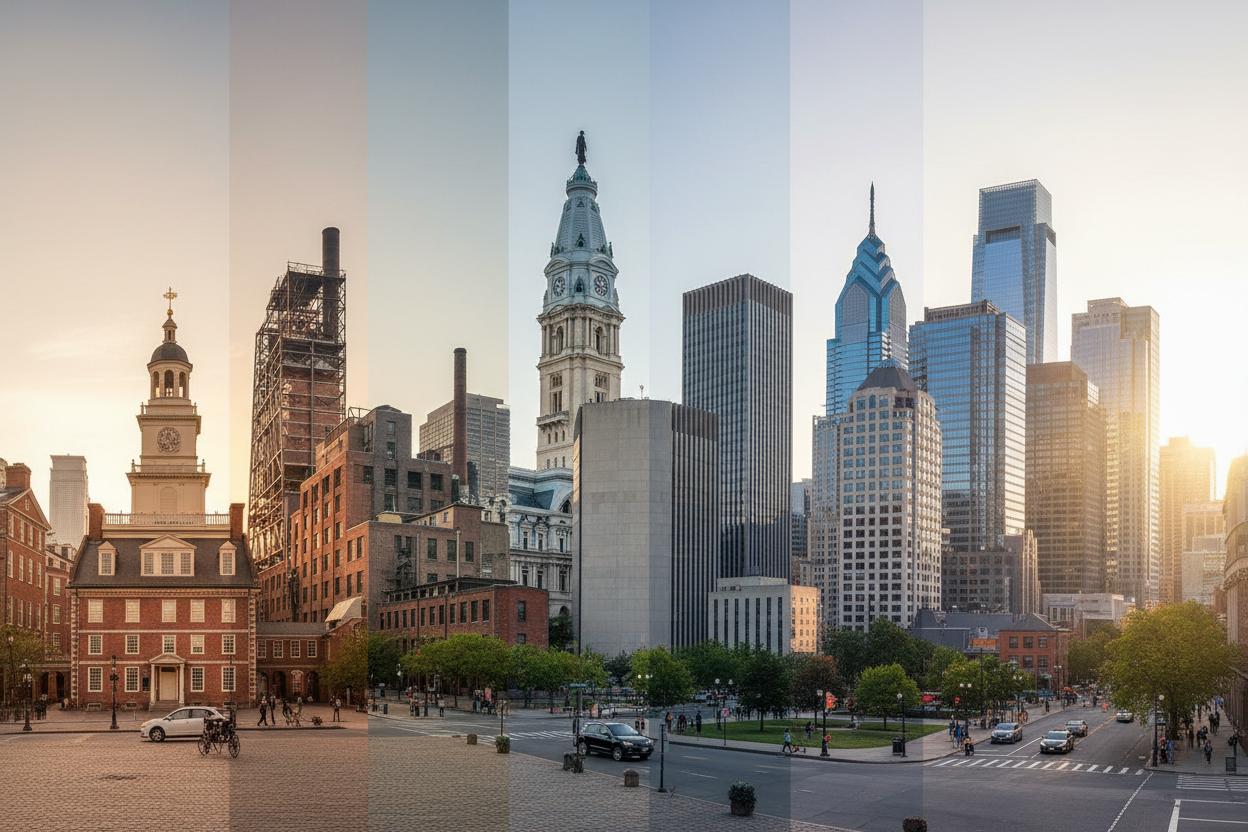
The 19th century brought dramatic changes to Philadelphia’s architectural landscape as the Industrial Revolution transformed both the city’s economy and its physical appearance. Steam power and new construction techniques enabled builders to reach unprecedented heights, while the city’s growing prosperity as a manufacturing center demanded larger, more impressive structures.
The construction of the Second Bank of the United States in 1824 marked Philadelphia’s entry into the age of monumental architecture. Its Greek Revival style and imposing presence signaled the city’s growing financial importance. However, it was the mid-century commercial boom that truly began reshaping the skyline, as multi-story warehouses, factories, and office buildings started filling the spaces between colonial structures.
Railroad development played a crucial role in this transformation. The Pennsylvania Railroad’s Broad Street Station, completed in 1881, introduced a new scale of architecture to the city. Though demolished in 1953, this massive structure demonstrated Philadelphia’s embrace of the grand architectural statements that were becoming commonplace in America’s growing cities.
The Gentleman’s Agreement: City Hall and the Height Restriction Era
Perhaps no single building has influenced Philadelphia’s skyline more profoundly than City Hall. Completed in 1901 after 30 years of construction, this Second Empire masterpiece topped with Alexander Milne Calder’s 37-foot bronze statue of William Penn became the tallest masonry building in the world at 548 feet. More importantly, it established what became known as the “gentleman’s agreement”—an unwritten rule that no building should rise higher than Penn’s hat.
This informal height restriction, lasting from 1901 to 1987, created one of America’s most distinctive urban skylines. While cities like New York and Chicago raced skyward during the early 20th century, Philadelphia maintained a uniquely horizontal profile. The city developed outward rather than upward, creating neighborhoods of consistent scale and preserving sight lines to City Hall from throughout the metropolitan area.
During this period, Philadelphia’s skyline was characterized by elegant Art Deco and Beaux-Arts buildings that maximized their impact within the height constraints. The PSFS Building, completed in 1932, pushed the boundaries of the gentleman’s agreement while introducing International Style modernism to the city. At 491 feet, it remained respectfully below Penn’s hat while demonstrating that architectural innovation could thrive within limitations.
Breaking the Gentleman’s Agreement: The Modern Era Begins
The 1980s marked a pivotal moment in Philadelphia’s architectural history when developers finally challenged the long-standing height restriction. The construction of One Liberty Place in 1987 shattered the gentleman’s agreement, rising 61 stories and 945 feet into the sky—nearly 400 feet taller than City Hall. This postmodern tower, designed by Helmut Jahn, sparked intense local debate but ultimately opened the floodgates for high-rise development.
The decision to break the height restriction reflected broader economic pressures facing Philadelphia in the 1980s. The city was losing corporate headquarters to other metropolitan areas, and civic leaders recognized that modern businesses expected modern office towers. One Liberty Place’s success in attracting tenants validated the decision to abandon the height restriction, though not without controversy among preservationists and longtime residents.
Two Liberty Place followed in 1990, creating Philadelphia’s first true high-rise cluster outside of City Hall’s immediate vicinity. These towers introduced a new architectural vocabulary to the city, featuring reflective glass facades, postmodern ornamental elements, and a scale that dwarfed the traditional cityscape. The transformation was dramatic and irreversible.
Contemporary Philadelphia: Balancing History and Innovation
Today’s Philadelphia skyline represents a fascinating dialogue between historical preservation and contemporary development. The Comcast Technology Center, completed in 2018 at 1,121 feet, currently stands as the city’s tallest building and the tallest building in the United States outside of New York City and Chicago. Its sleek glass design and LED crown represent the cutting edge of modern skyscraper technology while maintaining respectful proportions within the broader cityscape.
Modern Philadelphia development has embraced mixed-use concepts that would have been foreign to earlier eras. Buildings like the Residences at The Ritz-Carlton combine luxury condominiums, hotel space, and retail in single structures that activate street life while reaching toward the clouds. This approach reflects contemporary urban planning principles that prioritize pedestrian experience alongside vertical growth.
The city has also seen innovative adaptive reuse projects that preserve historical structures while accommodating modern needs. The conversion of industrial buildings in neighborhoods like Northern Liberties and Fishtown has created a secondary skyline of mid-rise developments that complement rather than compete with Center City’s towers. These projects demonstrate how Philadelphia continues to honor its architectural heritage while embracing change.
Architectural Styles Through the Decades
Philadelphia’s skyline serves as a living museum of American architectural movements. The colonial Georgian and Federal styles of the 18th and early 19th centuries gave way to the Greek Revival and Italianate buildings of the mid-1800s. The late 19th century brought Romanesque Revival and Second Empire styles, epitomized by City Hall’s elaborate stonework and mansard roofs.
The 20th century introduced Art Deco elements in buildings like the former Bell Telephone Company building, while the post-war era brought the clean lines of International Style modernism. The 1970s and 1980s saw Brutalist concrete structures that have since fallen from favor, though some, like the Municipal Services Building, remain significant parts of the cityscape.
Contemporary Philadelphia architecture embraces sustainability and technological innovation while often incorporating historical references. Green building techniques, energy-efficient systems, and mixed-use programming reflect current priorities, while materials and proportions often echo the city’s architectural heritage. This synthesis creates a skyline that feels both progressive and rooted in place.
The Future of Philadelphia’s Skyline
Looking ahead, Philadelphia’s skyline continues to evolve with several major projects in various stages of planning and construction. The proposed Schuylkill Yards development promises to create a new high-rise district near 30th Street Station, potentially adding multiple towers that could reshape the western approach to Center City. These projects reflect Philadelphia’s growing confidence as a major metropolitan area and its continued ability to attract significant investment.
Climate change and sustainability concerns are increasingly influencing new construction, with developers incorporating green roofs, energy-efficient systems, and environmentally responsible materials. The Philadelphia skyline of 2050 will likely feature buildings that generate their own energy, incorporate natural systems, and respond dynamically to environmental conditions.
Preservation efforts ensure that future development will continue to respect the city’s historical character. The National Historic Landmark status of Independence Hall and the surrounding area provides permanent protection for colonial-era structures, while local historic districts safeguard neighborhood character throughout the city. This balance between preservation and progress has become a defining characteristic of Philadelphia’s approach to urban development.
Conclusion: A Skyline That Tells America’s Story
Philadelphia’s skyline evolution from William Penn’s modest colonial vision to today’s gleaming towers reflects the broader American experience of growth, change, and adaptation. The city’s unique approach to development—respecting historical constraints for nearly a century before embracing vertical growth—has created a distinctive urban landscape that honors both past and future.
What makes Philadelphia’s skyline particularly compelling is its refusal to completely abandon its history in pursuit of modernity. William Penn’s statue still crowns City Hall, Independence Hall remains visible from multiple vantage points, and colonial-era churches continue to punctuate the urban fabric with their spires and steeples. This layered approach to development has created a skyline with unusual depth and character.
As Philadelphia continues to grow and change, its skyline will undoubtedly continue evolving. However, the lessons learned from three centuries of development—the importance of planning, the value of historical preservation, and the need to balance growth with livability—will continue to guide future changes. The result is a city whose skyline tells not just Philadelphia’s story, but America’s story, in steel, stone, and glass reaching toward the sky.